|
Last Place Heroes
 Rare
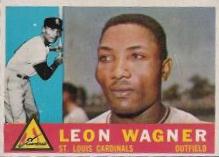
Cheers in Motown for "Daddy Wags" Rare
Cheers in Motown for "Daddy Wags"
DETROIT (July
31) -- Leon "Daddy Wags" Wagner and Hank Aguirre gave
Detroit and Los Angeles fans something to cheer about, winning
Player of the Week honors in late July. Wagner (.352-17-50)
hit .526 the week of July 26, hitting five home runs and driving in
nine runs. "Daddy Wags" hit two home runs in back to
back games against New York July 19-20, a week after hitting a
double against San Francisco. The 26-year-old left fielder --
a second round pick in 1958 -- is having a breakout year after
hitting .271-19-56 last year.
 Aguirre
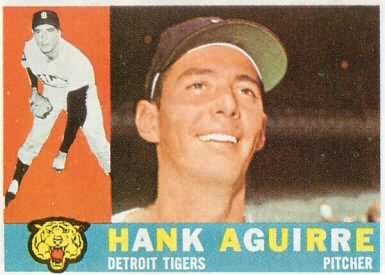
Breaks Slump Aguirre
Breaks Slump
Struggling
Outlaw Tosses Two-Hit Shutout
LOS ANGELES
(July 31) --
Los Angeles starter Hank Aguirre is having the worst year of his
career. Through 18 starts the 29-year-old southpaw was 2-15,
with a 7.01, but he broke out of his season-long slump in style with
a two-hit shutout on July 29, his second win in three starts.
The former Boston Beacon -- who drafted the Asuza, Calif. native
fourth overall in the 1956 draft -- is 2-1, 2.08 in his last three
starts.
Larsen
Rejuvenated, Hansen Responsible
by Doug Aiton
 WASHINGTON
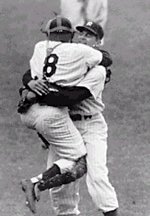
(July 31) -- Don
Larsen has never thrown more than 235 innings in a season -- this
year he's on course for 329. Larsen's career ERA before this
year was somewhere over 4.50, with him having never put up a year
better than 4.18. He's thrown as many complete games as in any
other season, he's already won 11 games behind a moribund offense
made up of the likes of Bill Serena, Bob Skinner and Preston Ward,
and he's on pace to strike out more than 170 batters. The
difference for the former 8th overall pick? "Confidence,"
says Larsen, "and Ron Hansen." WASHINGTON
(July 31) -- Don
Larsen has never thrown more than 235 innings in a season -- this
year he's on course for 329. Larsen's career ERA before this
year was somewhere over 4.50, with him having never put up a year
better than 4.18. He's thrown as many complete games as in any
other season, he's already won 11 games behind a moribund offense
made up of the likes of Bill Serena, Bob Skinner and Preston Ward,
and he's on pace to strike out more than 170 batters. The
difference for the former 8th overall pick? "Confidence,"
says Larsen, "and Ron Hansen."
The seventh
overall pick in the last amateur draft, shortstop Ron Hansen has
struggled at the plate since his arrival into the bigs, hitting just
.222 with an OBP of only .255 (in his defense, 10 doubles, 2 triple
and 5 homers have made him at least vaguely valuable). Out
there on the infield grass, however, Hansen has shone. He's
already turned 32 DPs (with no one steady partner -- Priddy, Serena
and Lumpe have rotated at 2B), and although he's made 10 errors, he
gets to more balls than even previous incumbent Gil McDougald.
Washington is currently tied for most DPs in the majors, despite
inconsistency (and terrible defense) at 1st, 2nd and 3rd base.
Perhaps pitching and defense could be the way ahead for the troubled
Monuments franchise?
 Founding
Fathers: Brad McNeely Founding
Fathers: Brad McNeely
The Man Who
Wasn't There, or What Goes Up Must Come Down . . . and Down . . .
and Down . . .
#5
of 8 part series by Glen Reed
To paraphrase
a long-standing philosophical inquiry, if a baseball team falls in
the standings and nobody's there to manage it, is it really a viable
side? The answer, if you're drunk enough, already philosophically so
inclined, or a long-suffering Detroit baseball fan, is
obvious--"No."
The Detroit UL franchise was the brainchild of one
Bradley McNeely, a twenty-something insurance salesman out of the
great state of Louisiana. McNeely had a decent initial draft,
which he rode to a second-place finish in 1951 -- the franchise's
high-water mark. But McNeely's side got worse every single
year in the league--finishing third in 1952, seventh in '53, eighth
in '54, and tenth (behind both expansion teams!) in '55, the season
that got him fired.
Expansion got him fired, too, because McNeely failed to
protect his #2-hitting Gold Glove second-sacker and a 33-year-old
Willard Marshall, who'd hit third in the Sound lineup ahead of the
great Ralph Kiner for much of the preceding season. Those decisions,
combined with essentially no moves to improve the side in the
re-entry draft or by way of trade, put the capper on that five-year
stretch of ever-greater futility that's unprecedented in league
history.
The charge of neglect rests in part on his trade
history, which shows only two moves during his five-year tenure, the
first a completely irrelevant 1951 deal of Al Sima for Fred Marsh.
Then comes the backbreaking 1952 trade in which a young Gene Conley
was dealt for lefty-hitting catcher Toby
Atwell and utility infielder Daryl Spencer. Some context helps, sort
of: In a case of gross oversight, Detroit had but two catchers on
their entire roster, and both went down for extended periods with
injuries in June of 1952. This resulted in the infamous
"Kiner-to-catcher" controversy, in which the
surefire Hall of Fame leftfielder spent an entire fortnight behind
the plate (in 13 games wearing the tools of ignorance, Kiner allowed
10 passed balls and threw out one of 16 would-be base stealers).
One opportunistic owner looking to accumulate pitching
prospects saw a chance and took it--Conley was taken seventh overall
in the 1952 rookie draft (two picks behind Stu Miller and one ahead
of Tom Gorman--the three account for two RoYs and three CYs), only
three picks ahead of Toby Atwell. Atwell was a highly coveted
(at least by me) lefty-hitting catcher, but looked redundant in the
Brooklyn organization to eventual 1953 Rookie of the Year winner
Smoky Burgess. So it seemed a reasonable trade at the time--McNeely
essentially moved down three spots in the 1952 draft to fill an
immediate, screaming need, and got another player thrown in for
kicks.
No one could have foreseen the massive talent upgrades that would
come Conley's way, making this trade, in hindsight, among the most
lopsided in UL history.
Certainly, McNeely cannot be charged with missing the
talent boat in his crack at the UL Initial Draft, which included
Granny Hamner and Rocky Bridges, the starting shortstops for two
recent WS teams. The much-loved Bob Porterfield. Kiner, who to this
point at least, is the greatest offensive player in UL history.
George Kell. Monte Irvin. Ferris Fain. Tons of pitcher picks.
Basically every other pick was a pitcher, but the problem is that
many underperformed, including the first pitcher taken in league
history and #3 overall pick Robin Roberts, who toils away to this
day in obscurity in Chicago's bullpen.
And we'd be remiss if we didn't mention one of the
all-time classic quotes in UL history--Bradley once famously wrote a
season summary article that referenced "finishing second last
year" when he'd actually finished seventh. Such was the
disconnect in Detroit that turned a once-promising UL
franchise into the subject of abstract philosophical debate.
|


