|
 H A L L O F F A M E I N D U
C T E E S
H A L L O F F A M E I N D U
C T E E S
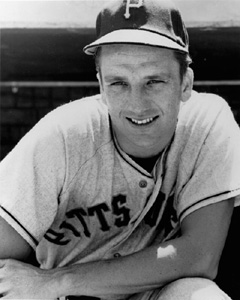 Ralph
Kiner ·
Elected 1965 Ralph
Kiner ·
Elected 1965
Left Field, Detroit Sound, Detroit Griffins, Brooklyn Superbas,
Washington Monuments ·
1951-1961
In 1951, Ralph
Kiner of the Detroit Sound burst into the inaugural UL
season with an MVP campaign and All-Star selection, on the back of 37
home runs, 127
RBIs, and 125 walks, leading the league in all three categories. He also
had the highest OBP and runs created that season (.435 and 132 respectively), and
hit .305 and scored 118 runs for with a team that would finish second, just
three games back. The greatest testament to Kiner's wonderful UL career
is that represented only the start of his production.
It would be another nine years before the Sound performed that well again,
and although Kiner dropped a beat with a .241/.381/.506 campaign in '52
(still, most sluggers would have been happy with that), by 1953 Kiner
was back to his dominant best. Again named to the All-UL team, Kiner
broke the league home run record with 41 and cemented his position as a bat
guaranteed to drive in 100, score 100 runs and walk 100 times every
year. '54 and '55 brought more success, another "Ullie", and
finally a big money contract - almost $40 million
over the next four seasons. But did financial security cause Kiner to lose
his edge?
It would seem not. Ralph Kiner's 1956 might have been the best
offensive season in the history of the UL - it was 180 points better in
OPS than any other campaign of his, and over 130 points better than any
other season in UL history. Even with missing a month due to an
inflamed cruciate ligament, Kiner hit 37 homers and drove in 114, with
a career high 48 doubles and 88 walks, finishing .346/.456/.735 to take home his second MVP (yet somehow, for the third year running,
the Sound lost over 90 games). While he never hit quite so well
again, the popular conception that Kiner begun to falter was wrong: in fact,
'57 and '58 were better offensive seasons than '54 and '55, as he hit 75
homers, drove in 257 and walked 232 times over those two years.
1958 was Kiner's last year in Detroit, as the renamed Griffins
sought to get younger. In a blockbuster trade, Kiner headed to division
rivals Brooklyn along with 3B Ray Jablonski in return for Minnie Minoso,
a bunch of arms and a couple of high draft picks. Kiner didn't settle
quite so well in Brooklyn as his contact skills diminished: Kiner
hit just .232, 50 points down from the year before, and only 13 homeruns.
His eye was still sharp, drawing 94 walks, but he arrived one year to
early (or two years too late) to capture that elusive
championship. Brooklyn let him walk that offseason, and the Monuments
swooped in to add the veteran to their roster on a three-year deal.
But Kiner
fell fast: a man who had struck out only 55 times in 532 ABs during his
rookie season whiffed an incredible 130 times in 357 ABs, hit only .196
with 24 extra-base hits. Kiner's eye still made sure he reached base at a .300
clip, but as a useful OF, Kiner's career was over. He struggled through
another 13 ABs in 1961 (striking out six times) in which he hit his
321st homer, drove in his 1059th run and recorded his 1082nd walk before
slipping into the minors. In January 1961, Kiner was named UL
Player of the Decade. At the end of that year, he retired.
Kiner's unproductive last seasons should not obscure his position as
one of the best hitters in UL history. During the first eight years of
the league, Detroit's own Kiner was the most devastating offensive force
in the game, averaging 37 homers, 118 RBIs and 115 walks a year, winning
two MVPs and making five All-Star teams. He finished with a career
.404 OBP, .544 SLG and .948 OPS, even with three down years at the tail
end of his career. He finished in the top three in OBP five times, SLG three times, OPS five times, RBIs seven times
as well as home runs and walkss eight times. The man from Santa
Rita, New Mexico was the greatest hitter in
the UL's first decade. The Hall of Fame awaits. (Doug Aiton)
AWARDS & ACCOLADES
Hall of Fame (1965)
Player of the Decade (1951-60),
All-Decade Team (1951-60)
Most Valuable Player (1951, 1956), All-UL
Team (1951, 1953, 1954, 1956, 1957), Gold Glove Award (1957)
Home Run
Champion (1951, 1953), RBI Champion (1951, 1953, 1956), OPS Champion
(1953, 1956)
5-time Batter of the Month, 14-time Player of the Week
|
Career Batting
Stats |
|
Year/Team |
Age |
G |
AB |
H |
2B |
3B |
HR |
RBI |
R |
BB |
K |
SB |
CS |
AVG |
OBP |
SLG |
OPS |
RC |
|
1951 Detroit |
27 |
151 |
532 |
162 |
29 |
4 |
37 |
127 |
118 |
125 |
55 |
1 |
1 |
.305 |
.437 |
.583 |
1.020 |
149.1 |
|
1952 Detroit |
28 |
149 |
510 |
123 |
28 |
1 |
35 |
97 |
111 |
122 |
72 |
4 |
0 |
.241 |
.388 |
.506 |
.894 |
112.4 |
|
1953 Detroit |
29 |
149 |
518 |
147 |
41 |
1 |
41 |
122 |
102 |
116 |
75 |
0 |
1 |
.284 |
.415 |
.604 |
1.019 |
141.8 |
|
1954 Detroit |
30 |
149 |
523 |
134 |
29 |
3 |
35 |
106 |
102 |
122 |
74 |
0 |
0 |
.256 |
.397 |
.524 |
.921 |
121.3 |
|
1955 Detroit |
31 |
146 |
511 |
128 |
31 |
6 |
37 |
119 |
104 |
118 |
83 |
0 |
0 |
.250 |
.391 |
.552 |
.943 |
122.3 |
|
1956 Detroit |
32 |
127 |
434 |
150 |
48 |
5 |
37 |
114 |
95 |
88 |
54 |
1 |
0 |
.346 |
.456 |
.735 |
1.191 |
155.8 |
|
1957 Detroit |
33 |
149 |
522 |
140 |
29 |
0 |
41 |
130 |
114 |
109 |
77 |
0 |
1 |
.268 |
.395 |
.559 |
.954 |
125.9 |
|
1958 DET/BRO |
34 |
143 |
468 |
132 |
27 |
0 |
34 |
127 |
100 |
123 |
58 |
1 |
1 |
.282 |
.431 |
.558 |
.989 |
125.9 |
|
1959 Brooklyn |
35 |
127 |
340 |
79 |
21 |
2 |
13 |
63 |
55 |
94 |
47 |
5 |
0 |
.232 |
.396 |
.421 |
.816 |
67.6 |
|
1960 Washington |
36 |
125 |
357 |
70 |
13 |
1 |
10 |
52 |
34 |
64 |
130 |
1 |
1 |
.196 |
.313 |
.322 |
.635 |
43.4 |
|
1961 Washington |
37 |
9 |
13 |
2 |
0 |
0 |
1 |
2 |
1 |
1 |
6 |
0 |
0 |
.154 |
.214 |
.385 |
.599 |
1.1 |
|
Total UL |
11 yrs. |
1424 |
4728 |
1267 |
296 |
23 |
321 |
1059 |
936 |
1082 |
731 |
13 |
5 |
.268 |
.404 |
.544 |
.948 |
1154.2 |
|
