|
 M E E T T H E R O O K I E S
· 1 9 6 4
M E E T T H E R O O K I E S
· 1 9 6 4
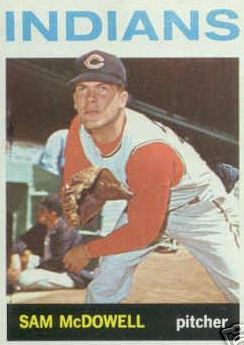 Sam
McDowell ·
SP,
#1 overall, Louisville Colonels Sam
McDowell ·
SP,
#1 overall, Louisville Colonels
McDowell seemed capable of
becoming the greatest strikeout pitcher the game had ever known, but by
1976 he was out of baseball, a victim of alcoholism.
A lanky 6'5" lefthander with a ferocious fastball, a good changeup, and
just enough wildness to keep hitters nervous, McDowell was overwhelming
from 1965 to 1970, winning five strikeout titles and twice fanning over
300 batters by the age of 28 (only
Sandy Koufax, Nolan Ryan,
Walter Johnson, and J.R. Richard have struck out 300 batters as many
times). McDowell started one game for the Indians as a 19-year-old in
1961, and found little success in Cleveland in 1962-63, walking almost
seven batters per nine innings. By 1964 he was beginning to harness his
tremendous talent, and in 1965 he dominated AL hitters. McDowell led the
AL with a 2.18 ERA, despite walking a league-high 132 batters, and
allowed only 178 hits in 273 innings while striking out 325, at the time
the fourth-best total in modern ML history. He struck out 15 Tigers in
10 innings June 5, and his 10.71 strikeouts per nine innings set a ML
record broken by Dwight Gooden in 1984.
Sudden Sam continued to terrorize AL hitters in 1966, leading the league
in strikeouts and shutouts and pitching back-to-back one-hitters. After
losing the strikeout title to
Jim Lonborg in 1967, he regained it in 1968, with 283, and recorded
a 1.81 ERA (second-best in the AL). He also walked a league-high 110. He
struck out 279 in 1969, and in 1970 McDowell was TSN Pitcher of the
Year with 20 wins and 304 strikeouts. He fanned 16 Angels on May 1,
1968, and 15 batters three more times.
His biggest problem was not batters. "I was the biggest, most
hopeless, and most violent drunk in baseball," McDowell would admit
later. He won only 13 games in 1971, walking a career-high 153, as his
drinking began to affect his on-field performance. He was traded to the
Giants for 1972, winning 10 games for the last time. He finished in the
Pirates' bullpen in 1975.
McDowell struck out 2,453 batters in his career. His total of 74 games
with 10 or more strikeouts is fourth behind Ryan, Koufax, and
Steve Carlton, and his career average of 8.86 strikeouts per nine
innings trails only Ryan and Koufax. He led the league in walks five
times and wild pitches three times, but averaged only seven hits allowed
per nine innings for his career. McDowell has been employed by the
Texas Rangers as a counselor to drug- and alcohol-addicted players.
(FK)
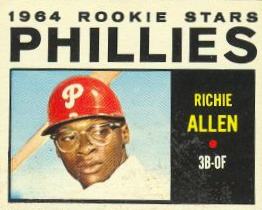 Dick
Allen
· 1B, #2 overall,
Detroit Griffins Dick
Allen
· 1B, #2 overall,
Detroit Griffins
Talented, controversial,
charming, and abusive, Allen put in 15 major league seasons, hitting
prodigious homers and paying prodigious fines. Called "Richie" at first,
in mid-career he became, adamantly, "Dick." He was praised as a money
player and condemned as a loafer. He made 41 errors at third base (which
he had not played in the minors) for the Phillies in 1964, but his 29
home runs, 91 RBI, 201 hits, and .318 BA earned him Rookie of the Year
honors. A deep cut on his
right hand, which he reported having suffered while pushing a stalled
car, affected his throwing and the Phillies made him a first
baseman/outfielder in 1967. He hit 40 home runs in 1966 and 177 through
1969, but off-the-field behavior brought him a 28-day suspension, a
$500-a-day fine, and a trade to the Cardinals at the end of '69. The
swap proved doubly controversial when Curt Flood refused to report to
the Phillies and challenged the reserve clause in court, forcing St.
Louis to substitute Willie Montanez.
The Cardinals passed Allen on to the Dodgers after one year, and they
traded him to the White Sox a year later. Each trade added to Allen's
reputation as an unmanageable loner. In 1972, with easygoing Chuck
Tanner as his White Sox manager, he led the AL in homers (37), RBI
(113), walks (99), and slugging percentage (.603) and was named MVP. In
1974, he was on his way to a similar year when he "retired" with a month
left to play, giving no reason. Despite his vacation, he led the AL with
32 home runs. The Sox traded him to Atlanta for cash and a player to be
named later in December 1974, but before he could play for the Braves
they sent him to the Phillies in May 1975 for Barry Bonnell, Jim Essian,
and cash. When Essian was turned over to Chicago as Atlanta's player to
be named later, he'd been swapped for Allen twice in less than half a
year. After two sub-par years in Philadelphia and one in Oakland, Allen
retired for good, still an enigma. His brothers Ron and Hank played in
the majors. (BC)
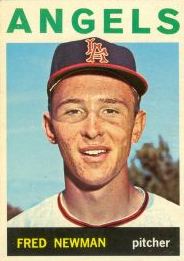 Fred
Newman
· SP, #3 overall,
San Francisco Spiders Fred
Newman
· SP, #3 overall,
San Francisco Spiders
Newman used good control to go 13-10,
2.75 (1964) and 14-16, 2.93 (1965) in his two best seasons.
(JFC)
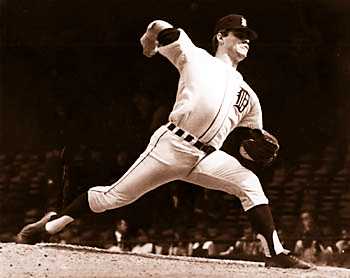 Denny
McLain
· SP, #4 overall,
Louisville Colonels Denny
McLain
· SP, #4 overall,
Louisville Colonels
He was brash. He was flamboyant. He
had a lounge act in Las Vegas. He performed on TV shows, including Ed
Sullivan's. He paraded about in a white mink coat. He was Hall of Fame
shortstop
Lou Boudreau's son-in-law. He was also convicted of racketeering and
smuggling cocaine and spent time in jail. And, for a while,
Denny McLain was one of the finest pitchers in baseball.
In 1968 McLain was the league MVP and a unanimous
Cy Young Award winner, going 31-6 with a 1.96 ERA, 28 complete
games, and 280 strikeouts. He was the first 30-game winner since
Dizzy Dean in 1934, and helped the Tigers to their first World
Championship since 1945.
McLain first came up in 1963 and he showed early flashes of brilliance,
winning 16 games in 1965, 20 in 1966, and 17 in 1967. He might have won
20 in 1967, if not for an unexplained accident at home where he hurt his
toe and missed his last six starts. His teammates, manager, and Tiger
fans thought he was dogging it, and he was blamed for the Tigers' close
second-place finish in a wild, four-team scramble for the AL pennant.
Starting 1968, he could do nothing to erase the fans' memory of the
previous season. He was booed at home after commenting that Detroit's
fans were "the world's worst." But soon the victories started to pile
up. He won nine straight starts from mid-June to mid-July to stretch his
record to 18-2. On September 1, he converted a
Boog Powell line drive into a triple play to preserve his 27th
victory. He was in the dugout when he won his 30th, a 5-4
come-from-behind victory over Oakland. In his 31st victory, he had a 6-1
lead over the Yankees, so he grooved a pitch to
Mickey Mantle in Mantle's last game in
Tiger Stadium. Mantle crashed what would be his next-to-last career
homer, passing
Jimmie Foxx on the all-time home run list. McLain would have won 33
games if not for two consecutive 2-1 losses.
In the 1968
World Series, McLain lost both starts in which he opposed the
Cardinals'
Bob Gibson, who had won 22 games and set a major league record with
a 1.12 ERA. But McLain won Game Six on two days' rest, setting up
teammate
Mickey Lolich to beat Gibson in the seventh game.
Many thought that his nonstop off-season partying would adversely affect
McLain, but his lifestyle didn't stop Tiger management from awarding
their cocky ace the team's first $100,000 contract. McLain responded by
winning a second Cy Young Award (he shared it with the Orioles'
Mike Cuellar) with a 24-9 mark and a team-record nine shutouts. But
things started to unravel midway through the 1969 season. He angered
manager
Mayo Smith by not showing up until the fourth inning of the
All-Star Game, which Smith wanted him to start. Then Sky King left
before the game was over, flying out in his private Cessna.
In 1970 things fell apart. On April 1, Commissioner
Bowie Kuhn suspended McLain for three months for a 1967 bookmaking
incident. In August McLain filed for bankruptcy, then dumped ice water
on a couple of Detroit writers. On September 9, Kuhn suspended him for
the rest of the season for gun possession. Finally, on October 9, after
a dismal 3-5, 4.65 season, he was traded to the Senators. Amid constant
run-ins with no-nonsense Washington manager
Ted Williams, McLain lost 22 games in 1971. He spent the 1972 season
in Oakland and Atlanta. At the age of 28, his fastball and money were
gone and his career was over. He put on weight. He tried several
businesses, all of which failed. In the early 1980s, he spent over two
years in jail before being granted a new trial and being released early
in 1989. As he began to reassemble his life, he played the organ in a
Michigan bar where Leon Spinks was the bartender, while listening to
offers from promoters looking to get him back in the spotlight. (SEW)
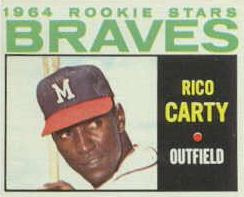 Rico
Carty
· LF, #5 overall,
Manhattan Gray Sox Rico
Carty
· LF, #5 overall,
Manhattan Gray Sox
High on any list of the great natural
hitters, the powerful Dominican called himself "the Big Boy." In 1960,
as a naive youngster, he signed ten pro contracts. When the mess was
straightened out, he became the property of the
Milwaukee Braves, who converted the slow-footed catcher into a poor
outfielder. As a rookie in 1964 he hit .330, losing both the batting
crown race (to
Roberto Clemente) and the Rookie of the Year award (to Richie
Allen). Tuberculosis sidelined him for the entire 1968 season; he spent
five months in a sanitarium. Incredibly, he returned to hit .342 in
1969, despite seven shoulder dislocations. His .366 in 1970 (highest ML
average since
Ted Williams hit .388 in 1957) led the NL, and he started on the
All-Star team as a write-in candidate. He broke his knee in a winter
ball collision, costing him the 1971 season, and nearly his career. He
was with three teams in 1973 and was playing in Mexico when the Indians
signed him as a DH for 1974. His 31 home runs in 1978, with Toronto and
Oakland, were a career high.
(JCA)
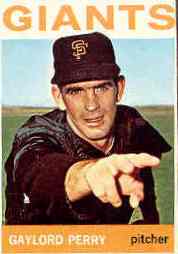 Gaylord
Perry
· SP, #6 overall,
Dallas Texans Gaylord
Perry
· SP, #6 overall,
Dallas Texans
Perry was the first pitcher to win
the
Cy Young Award in both leagues. Over 22 seasons, he won 314 games by
frustrating batters and umpires with his (allegedly) illegal pitches.
Perry signed a $90,000 contract with the Giants and won a regular spot
on the ML staff in 1963 after four years in the farm system. Pitching in
the shadow of the Giants' great righthander,
Juan Marichal, Perry didn't become a recognized star in his own
right until 1966. By August of that year he had an incredible 20-2
record, but he slipped in September to finish 21-8. Three good seasons
followed. On
September 17, 1968, he pitched a no-hitter to beat
Bob Gibson and the Cardinals 1-0. In 1970 he led the NL in victories
with a 23-13 mark. Perry won 134 games for the Giants before he was
traded to Cleveland in 1972.
Perry led the AL in wins in 1972, going 24-16 with a 1.92 ERA for the
fifth-place Indians. He was voted the AL Cy Young Award for 1972. He won
19 in 1973 and 21 in 1974 when he was joined by his brother Jim, a
longtime AL star, who won 17. Traded to Texas in
June 1975, he won 42 for the Rangers in two and a half seasons
before he was traded back to the NL. With San Diego in 1978, he went
21-6, led in winning percentage, and again received the NL Cy Young.
Perry was constantly accused of throwing a spitball, a charge he felt
gave him an edge against batters. He titled his autobiography Me and the
Spitter. He fidgeted constantly on the mound, touching his face, glove,
uniform, and the bill of his cap before delivering the ball. Umpires
nearly undressed him looking for jelly, grease, or Vaseline, and he
inspired new rules in 1973 about throwing the spitter. He remained
effective after several teams gave up on him, and won his 300th career
game for Seattle in 1982. (ArB/ArB/FS)
|
Bob Veale
SP, #7 overall, Washington Monuments
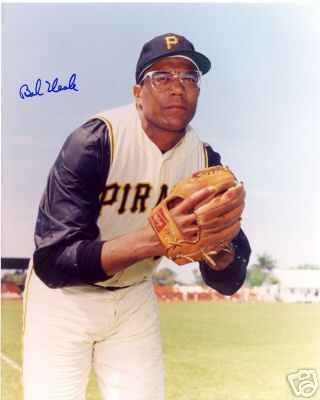 One
of the hardest throwers in the majors in an era dominated by
fireballers, Veale led the NL in strikeouts in 1964 and finished
second in 1965 and third in 1966. He struck out 16 Phillies in a
9-inning game (6/1/1965) and 16 Reds in 12 innings (9/30/1964).
His lifetime ratio of 7.96 strikeouts per nine innings ranks
fifth all-time (1,500-plus innings). But he also led four times
in bases on balls, tying the modern record, and walked 90 or
more every year he was in the rotation (1964-70). He won 67
games in his first four full seasons (1964-67), with seven
shutouts in 1965. But three losing seasons followed and he was
moved to the bullpen in 1971. He went 6-0 as Pittsburgh won the
1971 World Championship, but he posted a 7.04 ERA. Sold to
Boston in September 1972, he was the number two man out of their
bullpen in 1973, saving 11 games in his last good season.
(SFS) One
of the hardest throwers in the majors in an era dominated by
fireballers, Veale led the NL in strikeouts in 1964 and finished
second in 1965 and third in 1966. He struck out 16 Phillies in a
9-inning game (6/1/1965) and 16 Reds in 12 innings (9/30/1964).
His lifetime ratio of 7.96 strikeouts per nine innings ranks
fifth all-time (1,500-plus innings). But he also led four times
in bases on balls, tying the modern record, and walked 90 or
more every year he was in the rotation (1964-70). He won 67
games in his first four full seasons (1964-67), with seven
shutouts in 1965. But three losing seasons followed and he was
moved to the bullpen in 1971. He went 6-0 as Pittsburgh won the
1971 World Championship, but he posted a 7.04 ERA. Sold to
Boston in September 1972, he was the number two man out of their
bullpen in 1973, saving 11 games in his last good season.
(SFS)
|
Tony
Conigliaro
RF, #8 overall,
Louisville Colonels
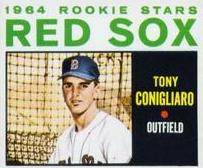 Tony
Conigliaro hit .290 with 24 home runs in 1964, but broke his
arm in August;
Tony Oliva won the AL Rookie of the Year award. When the
20-year-old Conigliaro hit 32 HR in 1965, he became the youngest
home run leader in AL history. The hometown hero was enjoying
another standout year in 1967 when, on August 18, he was struck
by a
Jack Hamilton fastball that broke his cheekbone and so
damaged his eyesight that he missed the entire 1968 season. He
returned in 1969 to win Comeback of the Year honors, and in 1970
hit 36 HR. But his vision was still impaired, and he left the
majors in
July 1971, returning for a short comeback try in 1975.
Further tragedy befell Conigliaro at age 37, when he suffered a
heart attack (while riding in a car with brother Billy) that
left him severely incapacitated. (TJ) Tony
Conigliaro hit .290 with 24 home runs in 1964, but broke his
arm in August;
Tony Oliva won the AL Rookie of the Year award. When the
20-year-old Conigliaro hit 32 HR in 1965, he became the youngest
home run leader in AL history. The hometown hero was enjoying
another standout year in 1967 when, on August 18, he was struck
by a
Jack Hamilton fastball that broke his cheekbone and so
damaged his eyesight that he missed the entire 1968 season. He
returned in 1969 to win Comeback of the Year honors, and in 1970
hit 36 HR. But his vision was still impaired, and he left the
majors in
July 1971, returning for a short comeback try in 1975.
Further tragedy befell Conigliaro at age 37, when he suffered a
heart attack (while riding in a car with brother Billy) that
left him severely incapacitated. (TJ)
|
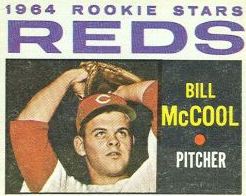
Billy McCool
MR, #9 overall, Boston Federals
McCool's 21 saves in 1965 and 18 in
1966 out of the Reds' bullpen tied him for the second-best NL
total both years, although his eight relief losses in '65 led
the league. In 1967
Ted Abernathy won the stopper role from him, and in 1968
McCool suffered a wrist injury.
(SFS)
 |
|
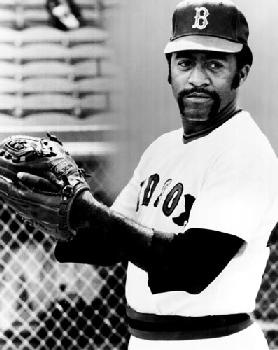 Luis
Tiant Luis
Tiant
SP, #10 overall,
Louisville Colonels
Tiant didn't join the Red
Sox until mid-career, but he became one of the most popular players in
club history. A balding, overweight starter whose age was often
estimated at several years higher that its "official" listing, Tiant
spoke with a thick Cuban accent and would smoke cigars anywhere,
including the clubhouse whirlpool and shower. He was a renowned
locker-room prankster, but was serious on the mound, winning 20 games
three times for Boston. He baffled hitters with a rocking, twisting
windup and an assortment of release points that ranged from over-the-top
to nearly underhand. Or as announcer
Curt Gowdy noted, "He comes everywhere except between his legs."
Tiant's father, Luis Tiant, Sr., was one of Cuba's greatest pitchers;
former All-Star
Bobby Avila signed the younger Luis to his first contract, for the
1959 Mexican League season. He set a Pacific Coast League record with a
.938 winning percentage (15-1) in 1964 before joining the Indians in
mid-season, and broke in with a four-hit shutout against the Yankees in
his first major league start. He went 10-4 with a 2.83 ERA as a rookie
in 1964, and in 1966 he pitched four consecutive shutouts. Tiant really
broke through in 1968 after he altered his delivery so that he turned
away from the plate during his motion, in effect creating a hesitation
pitch. He led the American League with a 1.60 ERA, 9 shutouts, and 5.3
hits per nine innings while striking out more than a batter an inning,
and finished 21-9. That July 3 he struck out 19 Twins in a ten-inning
game, setting an American League record for games of that length. In his
previous start he'd fanned 13 Red Sox, giving him a major league record
32 strikeouts in consecutive starts.
The Indians were overly protective of their newly hot property and
ordered Tiant to skip his usual winter ball. The strategy backfired when
he led the AL with 20 losses (while winning 9) and 129 walks in 1969.
After the season Cleveland traded him with
Stan Williams to the Twins for
Graig Nettles, former
Cy Young winner
Dean Chance,
Bob Miller, and
Ted Uhlaender. Tiant started the 1970 season with six straight wins,
but suffered a hairline fracture in his shoulder, missed June and July,
and wasn't the same when he came back. Minnesota released him at the end
of spring training in 1971, and he signed with the Braves minor league
Richmond club. He was cut a month later and rejoined Boston's Louisville
farm team. He made it back to the majors late that year, but went only
1-7.
Tiant was the Comeback Player of the Year in 1972 for a contending
Boston Red Sox team. He captured his second ERA title with a 1.91
mark and was 15-6. He followed his 20-13 mark in 1973 by going 22-13 in
1974, with an AL-leading seven shutouts. After helping the Red Sox to
the AL pennant in 1975 with an 18-14 mark (4.02 ERA) he got real
national attention for the first time during postseason play. He beat
the three-time World Champion A's in the ALCS opener with a
three-hitter, giving up only one unearned run, and followed with a
five-hit shutout of the Reds to open the
World Series. He also won Game Four, 5-4. Tiant got a hit in each
game after batting once all season, and his adventuresome trips from
base to base (he scored each time) while bundled in a warm-up jacket
provided comic relief in an otherwise tense series. His accent ("Ees
great to be weeth a weiner") and his eccentric cigar puffing made him an
immediate media favorite. He was rocked in Game Six, but left long
before
Carlton Fisk's 12th-inning homer ended what has been called the
greatest game ever played.
Tiant won 20 for the last time in 1976 (21-12), but he was no longer the
overpowering pitcher he once had been. For several years he had
increasingly relied on deception, with masterful changes of speed to go
with his wide variety of pitching motions. He pitched less, but he kept
winning, going 12-8 and 13-8 in his last two years with the Red Sox. He
signed with the Yankees as a free agent before the 1979 season and went
13-8, but was ineffective thereafter. (SH)
|
|
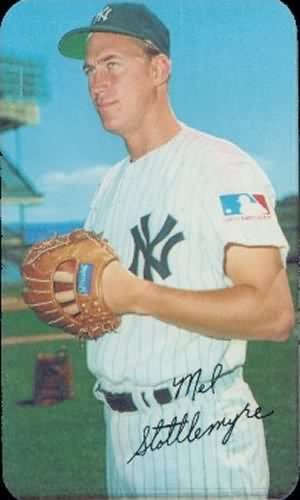 Mel
Stottlemyre Mel
Stottlemyre
SP, #11 overall,
Chicago Colts
Called up from Richmond in midsummer
1964 for the pennant race, the sinkerballer went 9-3 to help the Yankees
win their fifth consecutive AL pennant. In the World Series against the
Cardinals, he won Game Two with a complete-game 8-3 victory and pitched
well in Game Five, surrendering two runs in seven innings for a
no-decision. But, coming back on two days' rest (ace
Whitey Ford had arm trouble), Stottlemyre lost the final game when
he surrendered three runs in the fourth inning.
Even as the Yankee dynasty collapsed around him in 1965, Stottlemyre
went 20-9, leading the AL in innings and complete games. He led the
league with 20 losses in 1966, and tied for the lead with 18 losses in
1972, his only losing seasons before his final campaign. Through the
Yankees' fallow period he remained the classy, reliable staff ace and
had two more 20-win seasons (1968-69), serving as one of the team's few
ties to a more successful era. He pitched at least 250 innings in each
of his nine full seasons. A torn rotator cuff forced his retirement in
1974, just before the Yankees began a new era.
Stottlemyre is currently the Mets' pitching coach, and supervised the
conversion of
Dwight Gooden from a pure power pitcher to a wilier and hopefully
more durable style. His son Todd pitches for the Blue Jays, and Mel Jr.
played in the Mets' farm system.
(TJG)
|
Jim
Ray Hart
3B, #12
overall, Louisville Colonels
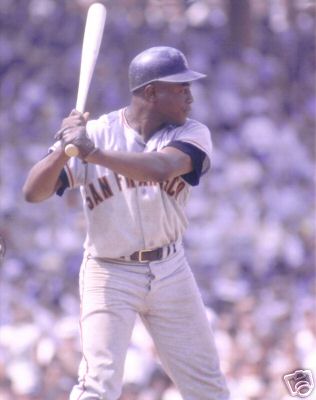 Bob
Gibson welcomed Jim Ray to the big leagues in 1963 by
breaking his shoulder blade with a fastball in the back. A few
days after Hart's return, he was beaned by
Curt Simmons and missed the rest of the season. Bob
Gibson welcomed Jim Ray to the big leagues in 1963 by
breaking his shoulder blade with a fastball in the back. A few
days after Hart's return, he was beaned by
Curt Simmons and missed the rest of the season.
But in 1964, his first full year, the stocky strongman proved he
wasn't gun-shy with a San Francisco rookie record 31 homers.
Until a 1969 shoulder injury made him a part timer, he averaged
28 homers a season. On
September 8, 1970 he hit for the cycle and tied a
major-league record with six RBI in one inning.
Although the former North Carolina cotton picker was so quiet it
was said a soft chuckle was a whole conversation for him, he was
vocal about his hatred of playing third base: it was "just too
damn close to the hitters." (JCA)
|
|
