|
 M E E T T H E R O O K I E S
· 1 9 6 3
M E E T T H E R O O K I E S
· 1 9 6 3
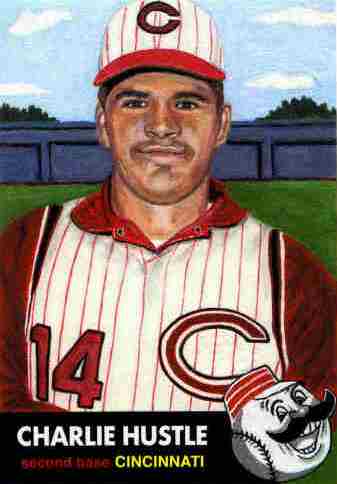 Pete
Rose ·
#1 overall, San Francisco Spiders Pete
Rose ·
#1 overall, San Francisco Spiders
Rose is the career leader in hits (4,256), singles (3,215), at-bats
(14,053) and games played (3,562). He is second all-time in doubles,
fourth in runs, and collected at least 100 hits in his first 23 seasons,
a record. He had more than 200 hits in a season 10 times, also a record,
led the league in hits in seven seasons, and is the most prolific
switch-hitter in history. He is the only player to play 500 games at
five different positions and was named the Player of the Decade for the
1970s by TSN. He revived the head-first slide and popularized running to
first base on a walk after seeing Enos Slaughter do it. Because of his
seemingly boundless enthusiasm, he was nicknamed "Charlie Hustle" by
Whitey Ford. Rose once said that he'd "walk through hell in a gasoline
suit to keep playing baseball." He has also been endlessly compared to
Ty Cobb, including allegations of betting on his own team, an accusation
Cobb faced in the final years of his career. Rose's statistical standing
in major league history is ensured, but his reputation and eventual
election to the Hall of Fame is in serious doubt following his lifetime
suspension by Commissioner Giamatti in 1989.
Born and raised in Cincinnati, the brash, crewcut rookie broke into the
Reds' starting lineup in 1963 and was named Rookie of the Year. In the
top of the ninth in a scoreless game in Colt Stadium on April 23, 1964,
Rose reached first on an error and scored on another error to make
Houston rookie Ken Johnson the first pitcher to lose a complete game
no-hitter. But Rose slumped late in 1964, was benched, and finished with
just a .269 average. He came back in 1965 to lead the league in hits
(209) and at-bats (670), and hit .312, the first of 15 consecutive .300
seasons. He hit a career-high 16 homers in 1966, then moved from second
base to the right field the following year. In 1968, he started the
season with a 22-game hit streak, missed three weeks, including the
All-Star game, with a broken thumb, then had a 19-game hit streak late
in the season. He had to finish the season 6-for-9 to beat out Matty
Alou and win the first of two close NL batting-title races. In 1969,
Rose and Roberto Clemente were tied for the batting title going into the
final game. Rose bunted for a base hit in his last at-bat of the season
to beat out Clemente. Rose's hustle won the All-Star Game in 1970 for
the NL, and may have spoiled the career of Oakland catcher Ray Fosse,
Rose's dinner companion the night before the game in Cincinnati. In the
12th inning, Rose led off with a single and went to second on a single
by the Dodgers' Bill Grabarkewitz. The Cubs Jim Hickman then singled
sharply to center. Amos Otis' throw beat Rose to the plate, but Rose
barreled over Fosse, separating the catcher's shoulder, to score the
winning run. Rose sparked the The Big Red Machine to a sweep of the LCS
against Pittsburgh that year. He drove in a run to snap a scoreless tie
in the 10th inning in the first game, then singled during the eighth
inning rally that produced the winning run in the third game.
In 1972, Rose, now in left field, again led the league in hits and
at-bats, hit .450 in the LCS against Pittsbugh, but managed only a .214
average in the seven-game loss to Oakland in the World Series. Rose
enjoyed his best-ever season in 1973. He won his third and final batting
title with a .338 average, collected a career-high 230 hits and was
named the NL MVP. The Reds, however, lost the LCS to the upstart Mets,
despite Rose's eighth-inning homer to tie Game One and his 12th-inning
homer to win Game Four. The Mets were spurred on by Rose's fight with
diminutive Met shortstop Bud Harrelson in Game Three, which prompted a
bench-clearing brawl. Rose slumped badly in 1974, hitting only .284,
although he did lead the league in runs scored with 110. In 1975, Rose
was moved to third base to make room for rookie outfielder Ken Griffey,
and led the Reds to the first of two straight World Series victories.
Rose was named the 1975 World Series MVP on the strength of 10 hits and
a .370 average. The Reds swept the Yankees in the 1976 Series, despite
only a .188 average for Rose. In 1978, Rose mounted the last serious
threat to Joe DiMaggio's 56-game hit streak. Rose hit safely in 44
straight games, the most by a NL player in the 20th century. On May 5,
he became the youngest player ever to reach 3,000 hits. After the
season, Rose became a free agent and, after a fierce bidding war, signed
with the Phillies. Installed at first base, his fifth position in the
majors, he hit .331. The next season, despite only a .282
regular-season average, he helped the Phillies win their first-ever
World Championship. With one out in the ninth inning of the sixth and
final game of the World Series, the Phillies were leading 4-1 with Tug
McGraw on the mound, but the bases were full of Royals. Frank White's
foul pop bounced out of catcher Bob Boone's glove, but Rose grabbed it
in the air to prevent a possible tragedy.
In the strike-shortened
1981 season, Rose led the league in hits and had his last .300 season,
batting .325. Now 40 years old, it was clear his career was winding
down, but the question of whether he could catch Cobb and the all-time
hit record of 4,192 kept his name in the news. The night after the
strike ended on August 10, he passed Musial as the NL all-time hit
leader. He hit just .271 in 1982, but collected 172 more hits. In 1983,
the last year of his contract with the Phillies, he hit just .245. Rose,
Joe Morgan, and Tony Perez, aging remnants of the Big Red Machine teams,
helped the Phillies to the World Series, losing to the Orioles in five
games. It was clear that the Phillies were moving toward youth, and the
question was, who would want a forty-two-year-old player. The Expos,
needing some help at the gate, signed him, and on April 13, a day before
his forty-third birthday, he collected his 4,000th hit. But he wasn't
hitting consistently, and was benched in July. On August 16, he was
traded back to his hometown Reds, was named player-manager, and
responded by batting .365 the rest of the season. In 1985 the city named
a street near the ballpark after him as the Cobb hoopla built. On
September 11 in Cincinnati, batting lefthanded, he hit a line single to
left off the Padres' Eric Show for hit number 4,193 to pass Cobb. In
order to reach Cobb, Rose collected more than 1,000 hits after the age
of 38. He guided the Reds to a second-place finish in the NL West that
year, and again in 1986, his last year as an active player. Cincinnati
finished second again in 1987, and for the fourth time in a row in 1988.
During the 1988 season, Rose got into a shoving match with umpire Dave
Pallone, and was suspended for 30 days.
Early in 1989, his job
in jeopardy because of consistant second-place finishes, Rose was
accused of being in massive debt to gamblers and of betting on his own
team. He resorted to months of legal stratagems, challenging the
Commissioner's authority, until finally agreeing on August 24 to a deal
in which he dropped his suit against baseball and accepted the lifetime
suspension. In return, there were no official findings announced. By
that time, testimony and documents from a federal case involving one of
his bookmakers had revealed everything anyway, but Rose obdurately
denied that he had done anything deserving censure. (SEW)
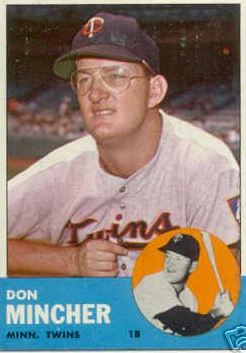 Don
Mincher
· #2 overall,
Washington Monuments Don
Mincher
· #2 overall,
Washington Monuments
Mincher was a
backup for Vic Power and
Bob Allison at the beginning of his career, and gradually won more
playing time. He hit 23 HR in just 287 at-bats in 1964 and earned the
lead position in a first-base platoon for the pennant-winning 1965 team.
He hit .251 with 22 HR and 66 RBI in 346 at-bats. In Game One of the
World Series, he homered in his first WS at-bat, off
Don Drysdale in the second inning, to give the Twins a lead they
never surrendered. He tied a WS record for first basemen with four
assists in Game Two as the Twins won again. However, he hit only .130
for the Series.
On June 9, 1966, Mincher contributed one of
the Twins' AL-record five homers in one inning. But Mincher's power
dropped off in 1966 (14 HR in 431 at-bats), and Minnesota traded him to
the Angels after the season. He rebounded in 1967 with 25 HR (tied for
fifth in the AL) and 81 runs, but on April 11, 1968 Mincher was beaned
by
Sam McDowell and suffered dizzy spells all season. Hitting only 13
HR, he was left unprotected in the expansion draft. Picked by the
Pilots, he came back once again with 25 HR and a career-high 78 RBI, and
the A's traded four players to acquire him and a throw-in for 1970. He
hit a personal-best 27 HR that year, but led AL first basemen in errors.
Mincher's power dropped in the next two
seasons as he was dealt to the Senators, who then moved to Texas (he is
the only person to play for both Senators teams and the Twins and
Rangers). The A's reacquired him for their 1972 pennant drive, and
although he hit only .148, there was one moment of glory left for him.
In Game Four of the
World Series against the Reds, the A's trailed 2-1 in the ninth
inning with one out and two on. Mincher's pinch-hit single off Reds
bullpen ace
Clay Carroll tied the score as the A's went on to win the game and
the Series. It was Mincher's final major league at-bat.
(SH)
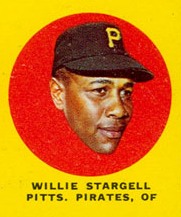 Willie
Stargell
· #3 overall,
Los Angeles Outlaws Willie
Stargell
· #3 overall,
Los Angeles Outlaws
As a young slugger, a superstar, and
a veteran captain, "Pops" always brought class -- and often victory --
to the
Pittsburgh Pirates. A menacing figure at the plate, Stargell would
slowly twirl his bat round and round as he prepared for the pitch,
almost like winding a powerful spring. Among his "collect-call" homers
were four into the upper deck at
Three Rivers Stadium, seven over the right field roof in
Forbes Field, two completely out of
Dodger Stadium (one of two players ever to accomplish the feat), and
a shot estimated at 535 feet into the 500-level at Montreal's
Olympic Stadium, where a seat is painted gold to commemorate the
shot.
On
July 22, 1964, Stargell hit for the cycle. That year, the burly,
lefthanded slugger began a string of 13 consecutive 20-homer seasons,
and also made his first of seven
All-Star Game appearances. In 1970 he tied a major-league record
with five extra-base hits in one game. He opened 1971 on a tear, setting
an April record with 11 dingers, and inspiring Pirate broadcaster
Bob Prince to coin the phrase "spread chicken on the hill" (in
reference to Willie's chain of chicken restaurants) each time he blasted
a homer. He spread chicken 48 times in 1971 and had 125 RBIs, both
career highs (as were his 154 strikeouts), to help the Pirates to a
pennant. In the
World Series dominated by
Roberto Clemente, he hit a disappointing .132.
When Clemente died, Stargell became the
Pirates' leader, but his spectacular 1973 season (.299, 44 HR, 119 RBI)
went largely unrecognized because the team slumped. Knee problems forced
his move to first base in 1974, and a series of injuries ended his
string of 20-homer seasons in 1977. However, he earned
The Sporting News Comeback Player of the Year award in 1978 when he
batted .295, tallying 28 homers and 97 ribbies.
Although he'd had seasons with higher
totals, 1979 was his most noteworthy year: At the ripe age of 39,
Stargell was captain of The Family, driving the team to a pennant with
his bat (.281, 32 HR, 82 RBI) and leadership, awarding "Stargell Stars"
to deserving teammates. In the World Series win, he set records with 25
total bases and seven extra-base hits (three homers, four doubles). He
also became the first person to win three major MVP awards -- sharing
regular season honors of the
National League with
Keith Hernandez, and also bringing home the NLCS and World Series
MVP trophies. Stargell's banner year also awarded him the titles of The
Sporting News Man of the Year, and Sports Illustrated co-Man of the Year
(with Steeler Super Bowl quarterback Terry Bradshaw). After playing
three more painful seasons with arthritis tearing away at his knees,
Pops retired in 1982 as the Pirate career leader in home runs, RBIs, and
eight other categories.
A clubhouse drug scandal in 1985 involving
Dave Parker,
Dale Berra, and even the Pirate mascot left a stain on the franchise
and fans yearning for their former leader. Stargell returned to the
Pirates as a coach after the scandal abated, but left with manager
Chuck Tanner for the
Atlanta Braves organization the following year. With the Braves,
Stargell served as first base coach, hitting coach, and later as a
Special Assistant to the Director of Player Development.
But despite his time with Atlanta, Stargell
was always a Pirate at heart. One of the most popular figures in
Pittsburgh sports history, he was given loud ovations at every public
appearance. When he was selected for the Hall of Fame by the BBWAA in
1988, his first year of eligibility, the Bucs took the opportunity to
retire his #8. Pops returned to the Pirates in 1997, working as an aide
to GM Cam Bonifay. Around that same time, he developed a kidney disorder
that would require constant dialysis, and leave him weak in the ensuing
years.
At the Three Rivers closing ceremony on
October 1, 2000, it was announced that a 12-foot high statue of
Stargell would be erected outside the Pirates' new home, PNC Park. The
statue was to be unveiled on April 7, 2001, but Stargell was too sick to
attend the event and the ceremony was postponed until two days later. On
the morning of the 9th, he passed away. (ME/AG)
 Jimmy
Wynn
· #4 overall,
Boston Federals Jimmy
Wynn
· #4 overall,
Boston Federals
Wynn, the Astros' first slugging
star, played most of his career in a big ballpark with a poor supporting
cast. The speedy, 5'9" outfielder had an explosive bat - hence the
nickname, the Toy Cannon. When he left Houston after 11 seasons, he held
club records in virtually every offensive category, including hits
(1,291), home runs (223), and RBI (719).
The Cincinnati native first signed with the
Reds, but was drafted from them by the expansion Houston club in 1962.
In 1965, Wynn's first full season, he led the Astros with a .275 batting
average, 22 home runs, and 73 RBI. He also stole a career-high 43 bases.
Two years later he broke club records with 37 HR and 107 RBI, but he
struck out a league-high 137 times. Seeing fewer good pitches to hit in
1969, he tied the NL record with 148 walks, but still hit 33 HR.
Wynn's career, and life, nearly ended when
he was stabbed in the abdomen during a quarrel with his wife in
December 1970. He recovered physically, but slumped dramatically in
1971, hitting just seven homers. He rebounded in 1972 (.273, 24 HR, 90
RBI), but another poor year in 1973 paved the way for his trade to the
Dodgers for pitcher
Claude Osteen. Wynn gave Los Angeles a desperately needed
righthanded power hitter, and replaced the recently traded
Willie Davis in centerfield.
Wynn carried the pennant-winning Dodgers for
the first part of 1974, hit three HR in a game for the second time in
his career, set a Los Angeles record with 32 HR, and was named TSN NL
Comeback Player of the Year. Nursing a sore elbow, he spent one more
season with the Dodgers before being sent to Atlanta in a six-player
deal for
Dusty Baker. He led the NL in walks a second time in 1976, but
batted just .207, and split a final, dreadful, 1977 campaign between the
Yankees and Brewers. (ME)
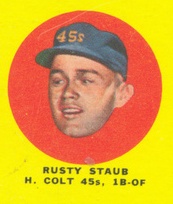 Rusty
Staub
· #5 overall,
Cleveland Barons Rusty
Staub
· #5 overall,
Cleveland Barons
Rusty Staub never resembled an athlete so much as a 205-lb Sherlock
Holmes who'd taken an intense interest in the game of baseball. Staub
began with modest natural skills and honed them to precision through
perpetual practice. Baseball was equal parts discipline and sport to
Staub, whose broad, curious world view attracted him to the study of
history and gourmet cookery. "He leads the league in idiosyncrasies,"
said one Staub observer. "He makes a science of getting ready to play to
the point where it almost becomes an obsession to him." For years, Staub
operated Rusty's restaurant on the Upper East Side of Manhattan. He'd
often embarrass teammates who joined him for dinner on the road by
sending his meal back two or three times until the chef got it right.
Staub retired with 2,716 hits and an
unmatched reputation as a batter. "He is a pure hitter," said
Duke Snider. Staub said, "I discovered at a very early age that
nothing was going to come easy for me, that I'd have to work for my
success." Despite a lack of speed, Staub led his league four times in
outfield assists. When he was placed at DH by the Tigers, he knocked in
a career-high 121 runs in 1978. The Mets made him a pinch hitter in his
final few years, and he tied records in 1983 for consecutive pinch hits
(8) and RBI (25), and had a record 81 pinch at-bats (he hit .296).
Staub signed with the Houston Colt .45s
(later the Astros) for $100,000 in 1961 and played in 150 games as a
19-year-old rookie. He and
Ty Cobb are the only players to homer before age 20 and after age
40, and Staub is the only player to appear in 500 games for four teams
and collect 500 hits for four teams. His short, lefthanded stroke
produced line drives and a .333 average for the Astros in 1967, with a
league-leading 44 doubles. Always popular, Staub became a national hero
(and was nicknamed Le Grand Orange for his red hair in French-speaking
Quebec) in Canada as a star for the expansion Expos. He hit 30 homers
for Montreal in 1970. A broken hand, his first major injury, sidelined
him with the Mets in 1972, but he played a dramatic role in the
postseason in 1973. Staub hurt his shoulder against the Reds in Game
Four of the playoffs when he caught
Dan Driessen's 11th-inning drive and smashed into the right-field
wall at
Shea Stadium. He took cortisone shots and threw underhand in the
World Series against the A's. Though unable to pull the ball, he
socked an opposite field homer off Oakland's
Ken Holtzman to win Game Four. (KT)
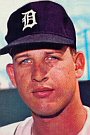 Mickey
Lolich
· #6 overall,
St. Louis Maroons Mickey
Lolich
· #6 overall,
St. Louis Maroons
Portly lefty Lolich stole the
spotlight from teammate
Denny McLain in 1968, despite McLain's 31-win season. Lolich won
three games in the 1968
World Series, giving up only five runs in his three complete games,
including a 4-1 victory in the seventh game against
Bob Gibson on two days' rest. In the sixth inning of that victory,
he picked off both Curt Flood and
Lou Brock. A notoriously poor hitter (a career .110 average), Lolich
cracked his only major league homer in Game Two of the Series off
Nelson Briles.
The picture of consistency throughout his
career, Lolich struck out 200-plus seven times and finished 12th
all-time in strikeouts with 2,832, second only to
Steve Carlton among lefties. Lolich was not a natural lefthander. A
childhood run-in with a motorcycle left him with a broken left
collarbone. Rehabilitating his left arm actually made it stronger than
his right. Lolich came up the same year as McLain but was far more
consistent, never winning fewer than 14 games in his 11 full years in a
Tiger uniform. In 1968, while McLain piloted planes and played the
organ, Lolich rode motorcycles and played the drums on his way to 17
wins, going 10-2 over the last two months of the season. In 1971 he had
a league-leading 25 victories and 308 strikeouts. He would have won the
Cy Young Award but for
Vida Blue's spectacular rookie season. Lolich won 22 the following
year with a career-best 2.50 ERA and again felt he deserved the
Cy Young Award, but he lost a close vote to Gaylord Perry.
Lolich was traded to the Mets for
Rusty Staub after the 1975 season, then "retired" after going 8-13
for New York in 1976. He sat out the entire 1977 season to get out of
his contract, then signed with San Diego for two final seasons.
(SEW)
|
Ken Harrelson
#7 overall,
Manhattan Gray Sox
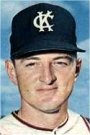 The
big and powerful Harrelson was baseball's 1960s flower child. He
wore his blond hair long and sported Nehru jackets, beads, bell
bottoms, and no socks. Catcher Duke Sims dubbed him "Hawk" for
his aquiline nose, and he had that emblazoned on the back of his
uniform. A careless-fielding power hitter, he hit 23 homers for
Kansas City in 1965. Late in 1967, Harrelson was quoted as
saying, "Charlie Finley is a menace to baseball." The angered
A's owner released him. Seven teams approached Harrelson; the
Red Sox, in the thick of a pennant race, won him with a $73,000
bonus, and Harrelson helped
them to the '67 pennant. In 1968, he hit 35 homers and led the
AL with 109 RBI. Boston fans picketed
Fenway Park early in 1969 when Harrelson was traded to
Cleveland. He missed most of 1970 with a broken leg and played
grudgingly for the Indians until 1971, when he quit to become a
pro golfer, something he had threatened for years. When that
failed, he became an outspoken broadcaster, and, for 1986, was
the White Sox' much-criticized GM.
(JCA) The
big and powerful Harrelson was baseball's 1960s flower child. He
wore his blond hair long and sported Nehru jackets, beads, bell
bottoms, and no socks. Catcher Duke Sims dubbed him "Hawk" for
his aquiline nose, and he had that emblazoned on the back of his
uniform. A careless-fielding power hitter, he hit 23 homers for
Kansas City in 1965. Late in 1967, Harrelson was quoted as
saying, "Charlie Finley is a menace to baseball." The angered
A's owner released him. Seven teams approached Harrelson; the
Red Sox, in the thick of a pennant race, won him with a $73,000
bonus, and Harrelson helped
them to the '67 pennant. In 1968, he hit 35 homers and led the
AL with 109 RBI. Boston fans picketed
Fenway Park early in 1969 when Harrelson was traded to
Cleveland. He missed most of 1970 with a broken leg and played
grudgingly for the Indians until 1971, when he quit to become a
pro golfer, something he had threatened for years. When that
failed, he became an outspoken broadcaster, and, for 1986, was
the White Sox' much-criticized GM.
(JCA)
|
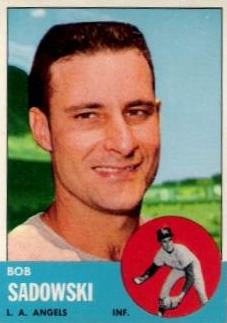
Bob Sadowski
#8 overall,
Cleveland Barons
 |
|
Pete Ward
· #9 overall,
Manhattan Gray Sox
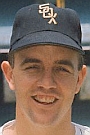 Dean
Chance once called the dumpy, rumpled Ward the league's toughest
clutch hitter. In the 1960s, he was as close as the White Sox came to
having a consistent power threat in spacious
Comiskey Park. The son of NHL star Jimmy Ward, he was acquired as a
throw-in (at the insistence of White Sox coach Charlie Metro, Ward's
first minor league manager) in the blockbuster deal that brought
Ron Hansen, Dave Nicholson, and
Hoyt Wilhelm from the Orioles in return for
Luis Aparicio and
Al Smith. Placed at third base to replace Smith, he showed good
range but led AL third basemen with 38 errors, most of them attributable
to his strong but scattershot throwing. But White Sox pitchers didn't
complain; he beat Detroit with a seventh-inning HR on Opening Day, the
start of an 18-game hitting streak. For the season Ward hit .295, fifth
in the AL, with 22 HR, 84 RBI, and 80 runs, and he finished second in
the AL in total bases (289), hits (177), and doubles (34). TSN named
him AL Rookie of the Year. Dean
Chance once called the dumpy, rumpled Ward the league's toughest
clutch hitter. In the 1960s, he was as close as the White Sox came to
having a consistent power threat in spacious
Comiskey Park. The son of NHL star Jimmy Ward, he was acquired as a
throw-in (at the insistence of White Sox coach Charlie Metro, Ward's
first minor league manager) in the blockbuster deal that brought
Ron Hansen, Dave Nicholson, and
Hoyt Wilhelm from the Orioles in return for
Luis Aparicio and
Al Smith. Placed at third base to replace Smith, he showed good
range but led AL third basemen with 38 errors, most of them attributable
to his strong but scattershot throwing. But White Sox pitchers didn't
complain; he beat Detroit with a seventh-inning HR on Opening Day, the
start of an 18-game hitting streak. For the season Ward hit .295, fifth
in the AL, with 22 HR, 84 RBI, and 80 runs, and he finished second in
the AL in total bases (289), hits (177), and doubles (34). TSN named
him AL Rookie of the Year.
Lefthanded-hitting Ward used a
strange batting stance, crouching with his rear foot pointed
straight at the plate and his front foot pointed at the pitcher,
and he had a big uppercut. Ward himself observed, "I got a real
silly stance. Fundamentally I got a bad swing." He had career
highs of 23 HR (including three grand slams) and 94 RBI in 1964
and cut his errors in half (19), but in 1965 he was bothered by
recurring muscle spasms in his neck (the result of a minor auto
accident in the off-season). He dropped off to 10 HR, 57 RBI,
and a .247 average. A back injury in 1966 cut even deeper into
both his playing time and his production (84 games, .219, 3 HR)
and forced a move into the outfield. He rebounded somewhat in
1967 with 18 HR and 62 RBI in 467 at-bats, playing outfield,
first base, and third, but he hit only .233 and struck out a
career-high 109 times.
The White Sox lineup was getting
weak in the late 1960s (Ward's 18 HR in 1967 led the team, with
Tommie Agee at 14 and Tom McCraw at 11 the only others in
double figures), and Ward saw fewer good pitches; he walked 61
times in 1967 and 76 times in 1968, his last decent season (15
HR, .216). By 1969 he was a utility man, but he did pinch hit
.370 (17-for-46). He finished his career in limited duty with
the Yankees in 1970.
(SH)
|
Bob Bailey
· #10 overall,
Dallas Texans
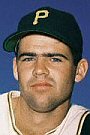 Bailey
signed with the Pirates for what was believed to be a record bonus of
$175,000 in 1961. He was TSN Minor League Player of the Year in 1962
and the regular Pirate third baseman for the next four years. The
Dodgers traded
Maury Wills for Bailey and Gene Michael in December 1966, but Bailey
hit only .227 for two consecutive years, and Los Angeles sold him to the
expansion Expos. Bailey
signed with the Pirates for what was believed to be a record bonus of
$175,000 in 1961. He was TSN Minor League Player of the Year in 1962
and the regular Pirate third baseman for the next four years. The
Dodgers traded
Maury Wills for Bailey and Gene Michael in December 1966, but Bailey
hit only .227 for two consecutive years, and Los Angeles sold him to the
expansion Expos.
Bailey hit well for the Expos.
Manager
Gene Mauch often said: "Bailey means wood. Bailey doesn't
mean leather." An opponent added: "They called him Beetle, after
the comic strip character. He fielded like a comic strip
character." As the starting third baseman in 1972-73, he made 39
errors. Mauch also tried him at 1B and OF.
The Montreal fans developed a
love-hate relationship with the slow-footed streak hitter who
grounded into 216 lifetime double plays. In 1970 Bailey hit .287
with 28 homers, including one of the longest shots in
Astrodome history on August 16. When he was traded in
December 1975, he was the leader in nine of ten Expo career
batting categories.
(JCA)
|
|
Al Downing
· #11 overall,
Chicago Colts
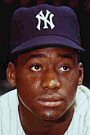 Al
Downing, who gave up
Hank Aaron's record-breaking 715th homer, entered baseball loaded
with potential. His fastball exploded and his curveball danced. Called
by some "the black
Sandy Koufax," he never lived up to that billing, partly because of
control problems and inconsistency and later because of arm miseries,
but for four seasons he was excellent. Al
Downing, who gave up
Hank Aaron's record-breaking 715th homer, entered baseball loaded
with potential. His fastball exploded and his curveball danced. Called
by some "the black
Sandy Koufax," he never lived up to that billing, partly because of
control problems and inconsistency and later because of arm miseries,
but for four seasons he was excellent.
Recalled from the minors to the
Yankees for good in
June 1963, Downing maintained a summer-long electric pace of
low-hit games. The first black starting pitcher in club history
allowed a scant 5.84 hits per nine innings and finished with a
13-5 record. In 1964 he led the league with 217 strikeouts.
Downing in 1967 became a complete pitcher, cutting down on his
walks, mastering a changeup and mixing up his pitches. He
finished 14-10 with the ninth-place Yankees. Pitching for
the Dodgers in 1971, Downing reached the pinnacle, winning 20
games, including a league-leading five shutouts. (MG)
|
Jimmie Hall
#12 overall, Manhattan Gray Sox
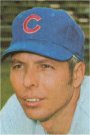 XHall's
career-high 33 HR in his rookie season ranked fourth in the AL
in 1963. The Twins' centerfielder by default, he didn't cover
enough ground but gave Minnesota a powerful outfield trio when
he played with
Bob Allison and
Harmon Killebrew or
Tony Oliva. His best year came in the Twins' 1965 AL
championship season, when he reached career highs in BA (.285),
RBI (86), steals (14), and doubles (25). After dropping to .239
in 1966, he was traded to the Angels, for whom he had one more
decent season before declining. He played for five teams in his
last three seasons.
(SFS) XHall's
career-high 33 HR in his rookie season ranked fourth in the AL
in 1963. The Twins' centerfielder by default, he didn't cover
enough ground but gave Minnesota a powerful outfield trio when
he played with
Bob Allison and
Harmon Killebrew or
Tony Oliva. His best year came in the Twins' 1965 AL
championship season, when he reached career highs in BA (.285),
RBI (86), steals (14), and doubles (25). After dropping to .239
in 1966, he was traded to the Angels, for whom he had one more
decent season before declining. He played for five teams in his
last three seasons.
(SFS) |
|
